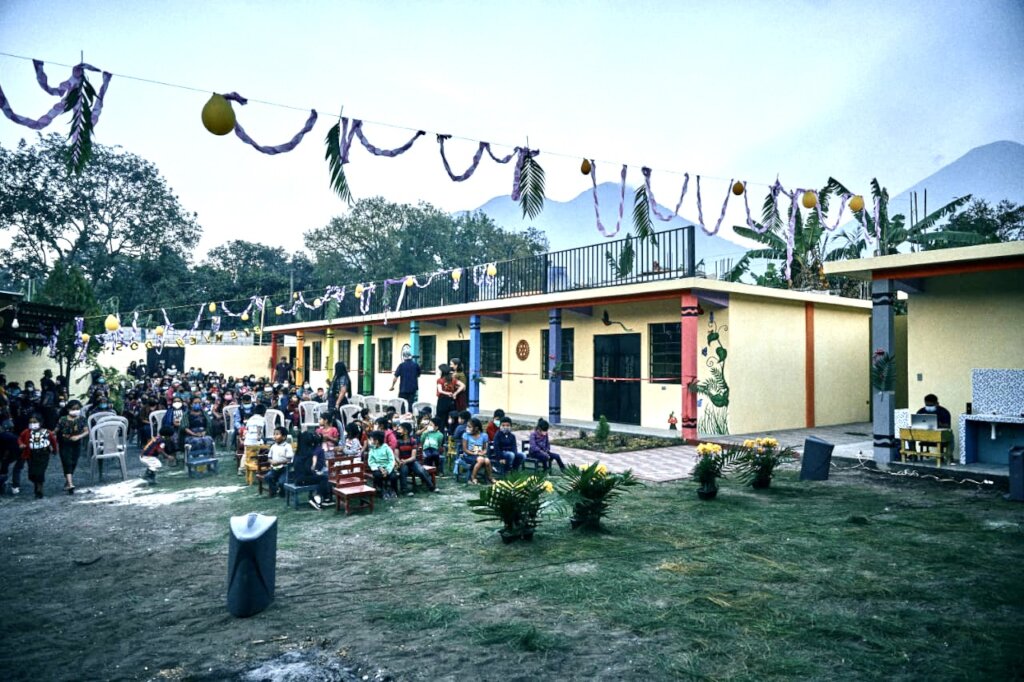
![The school building for the biodigester]()
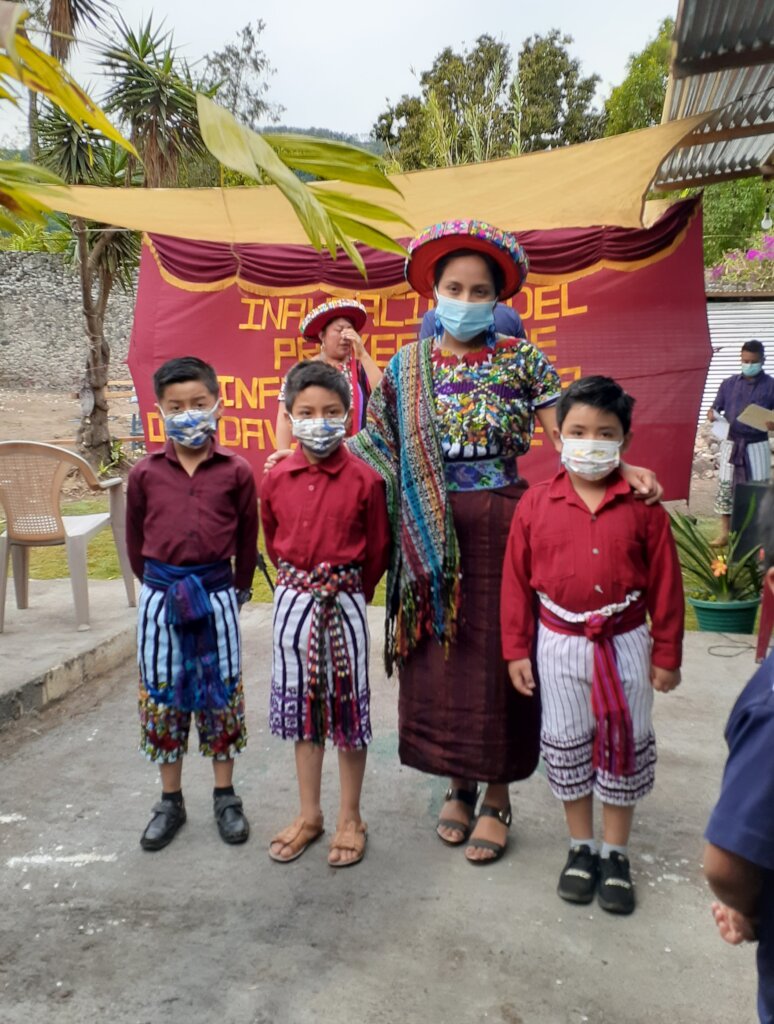
The school building for the biodigester
Dear Friends and Supporters:
First of all, the Tui’k Ruch’Lew team is wishing you and yours a very happy new year to come. Cheers to health, happiness, and prosperity in 2022!
Update on the “Poop to Fuel” project
Good news first: Last year, we raised about 70% of the funds we need to realize the biodigester demonstration project. In addition to our fundraising efforts, we have dedicated the past year to developing the concept for this project. To this end, we have worked together with volunteer experts from various fields, e.g. anthropology, engineering, sustainable development. Over the summer months we developed the workshop programme we will need to actively involve the community in this demonstration project. The active participation of community members is not only important for the success of the project at the school, but also to make alternative sanitation solutions tangible to everyone.
Workshop series for the “Poop to Fuel” project
1. Organic kitchen scraps are a resource not waste
This workshop focuses on community participation and raising awareness about natural resources. Community members (parents of the children at the David Lamotte school) will learn that kitchen waste, like human excreta, contains valuable raw materials that can and should be reused. The aim is for pupils to bring kitchen waste from their households to school to feed the biogas plant. This would make Tzanchaj, where the school is located, the first community in Santiago Atitlan to take care of its own “waste” Adding organic waste will be crucial for the carbon-nitrogen balance. We also envision a IoT device that will monitor the pH and the C/N ratio automatically, so that the project manager will be notified when the biodigester is out of balance.
2. Safe sanitation means a clean environment
The underlying purpose of sanitation interventions is to protect public safety. Together with the participants, we will :
- Assess the current water and sanitation situation.
- Assess and prioritize the public health risks associated with poor sanitation.
- Discuss water and sanitation in the Maya cosmovision.
- Discuss the value of human excreta as a natural resource.
- Discuss different sanitation solutions (e.g. pit latrines, septic tanks, drainage systems) and their advantages and disadvantages.
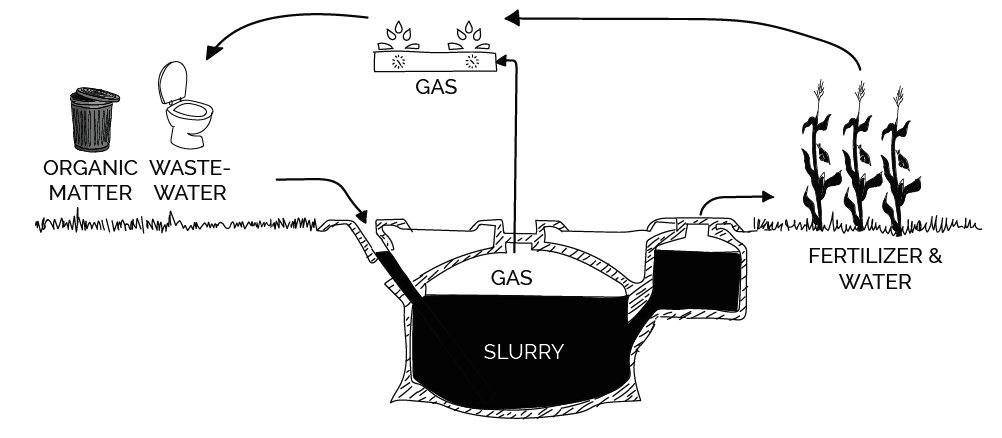
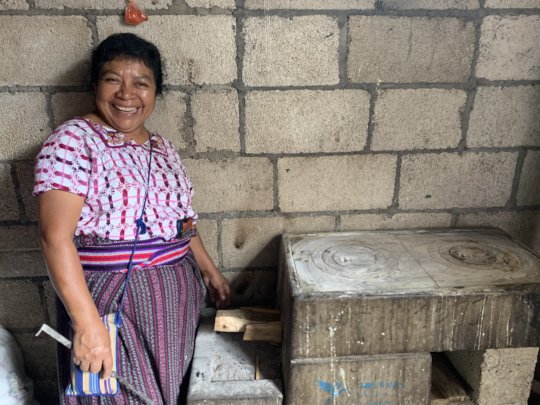
- Introduce the concept of the biodigester (function, operation, maintenance) and its byproducts (gas for cooking, fertilizer for the fields).
- Identify possible barriers to successful implementation of the biodigester project.
- Develop activities to support changes in behavior and practice.
3. The community leads the biodigester project
This workshop focuses on the importance of community involvement. For example, a local woman should run the biodigester in the mid- to long-term. The workshop also encourages the community to become active members in finding solutions for its environmental and health problems.
Workshop leaders will use human-centered methodologies from Design Thinking and Transactional Analysis. All workshops will be held in the local Maya Tz’utujil language and playful methods and small group activities should help get the community interested in participating. Group discussions will be encouraged. Once we have the community members involved, we will widen the audience and show the system to local authorities like the COCODES, mayors, and indigenous community leaders.
Design planning
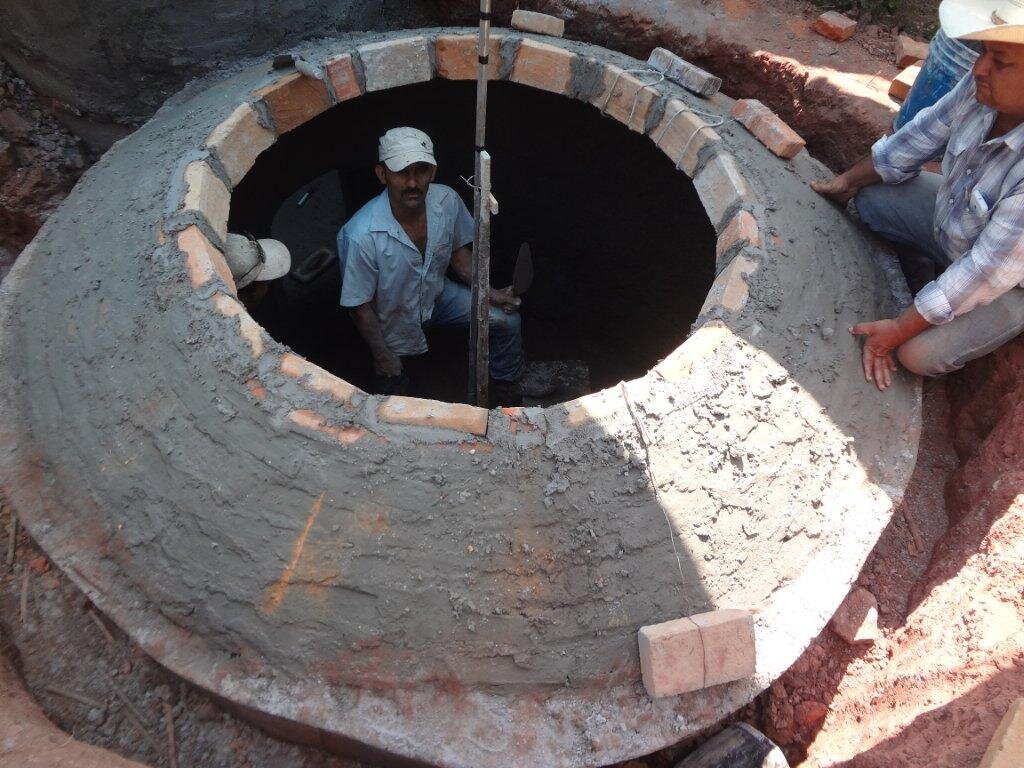
This summer, we worked together with an electrical and computer engineering student from Princeton University on a three-dimensional computer-aided design (CAD) for the fixed dome biodigester. Using this model, the amount of gas can be calculated based on different input variables (different proportions of urine/feces ratios, water input, and so on).
Based on the calculations and the experience of our partners in Honduras and Cuba, we decided on a six cubic meter, fixed dome biodigester for the demonstration project at the David LaMotte school in Tzanchaj.
Implementation plan
The installation/construction of the fixed dome biodigester will take about 1 week. The timing of the installation is yet to be determined.
Operation and maintenance will remain with Tui'k Ruch'Lew, but as already noted, we envision a local woman from the community taking over this part at some point.
Obstacles
The timing for project implementation is not yet fixed. We continue to face several obstacles:
- David LaMotte School has not received primary school accreditation for 2022. Accreditation was planned for mid-2021. During the accreditation phase, however, shortcomings were discovered, resulting in postponement of full accreditation. We are waiting to see what happens. It is worth noting that the biodigester system can be retrofitted at any time.
- However, due to COVID restrictions, most likely, schools will be closed throughout 2022, i.e. in-person classes are still suspended in Guatemala. If no one is pooping in the biodigester, no gas can be produced to demonstrate the circular system. Smooth operation is crucial for a successful demonstration project.
- Tui’k Ruch’Lew is also faced with serious funding issues. Given these obstacles, hiring someone for the biodigester project (project manager/social worker) would be inappropriate at this point.
Know that your donations have been set aside. We hope to be able to activate this project as soon as all uncertainties have been eliminated..
Wishing you all a wonderful day and a great start to 2022,
Jessica and the Tui'k Ruch'Lew team
![Safe sanitation for the healthy pupils]()
Safe sanitation for the healthy pupils
Links:
![Share on Twitter]()
![Share on Facebook]()