By Ansh Jakatimath | HAF Intern
Morocco has been at the forefront of social change. An early trailblazer in the emphasis of gender equality and opportunity, Morocco has led the Maghrib through both royal decree and public understanding.
King Mohammed VI began his term promptly highlighting such values through his alteration of the Moroccan Moudawana, the set of familial laws, creating several structural changes in the likes of raising the minimum age of marriage, restricting polygamy, and granting women greater rights in the processes of divorce and child custody.
Morocco through its action has proven its commitment for gender progress.
But, while the spotlight of the country aims to move in the direction of granting more rights and protections for women, many systemic problems relating to the men of Morocco risk being ignored.
The vast majority of communities in the nation are strict in their patriarchal and rigid definitions of masculinity and what it means to ‘be a man.’
Men are perceived as providers and protectors, who are stoic in their pursuits, all the while masking their true emotions and hardships. The lack of outlets for the open expression of emotions leads to increased feelings of isolation.
Whilst this can be harmful on the individual level, it also points to the larger structural issue of the absence of healthy male discourse, woven into the fabric of Moroccan culture.
The question then becomes, how can the Moroccan man not be left behind in the constantly evolving, modern Morocco?
It is in this context that Professor Craig, Upson Chair of Public Discourse and Professor of Theatre at Hamilton College in Clinton, New York, in partnership with the High Atlas Foundation, has proposed a new empowerment workshop based on a unique methodology that merges theatre with meaningful interpersonal exchange.
Inspired by the work of Brazilian theatre practitioner Augusto Boal, Professor Latrell has curated a forum theatre experience to engage Moroccan men in discussions on masculinity in a contemporary and constructive way.
Boal's forum theatre approach transforms spectators into ‘spect-actors,’ where the acting of a scene is paused and subsequently audience members are asked to reflect on and offer creative solutions to key dilemmas.
Questions like: “What would you have done at this moment?” or “Is this ‘manly’?” are asked by the facilitator, with the spect-actors taking on the protagonist’s role and acting out alternative solutions.
The workshop aims to leverage shared community values such as family well-being, community resilience, and collective prosperity to examine how inflexible adherence to current gender roles serves as an obstacle to development, and to come to an understanding of alternative views of masculinity in a more flexible, supportive and ultimately beneficial way.
Designed in a “fun” and flexible way, the workshop can travel from village to village, adapting to the cultural contexts of each community, delivering dialogue and exercises that will incite reflection and positive actions within the local male community.
As a student collaborator working to help refine the workshop program, I helped Professor Latrell undertake a “Training of Trainers” session with High Atlas Foundation staff members on June 15th.
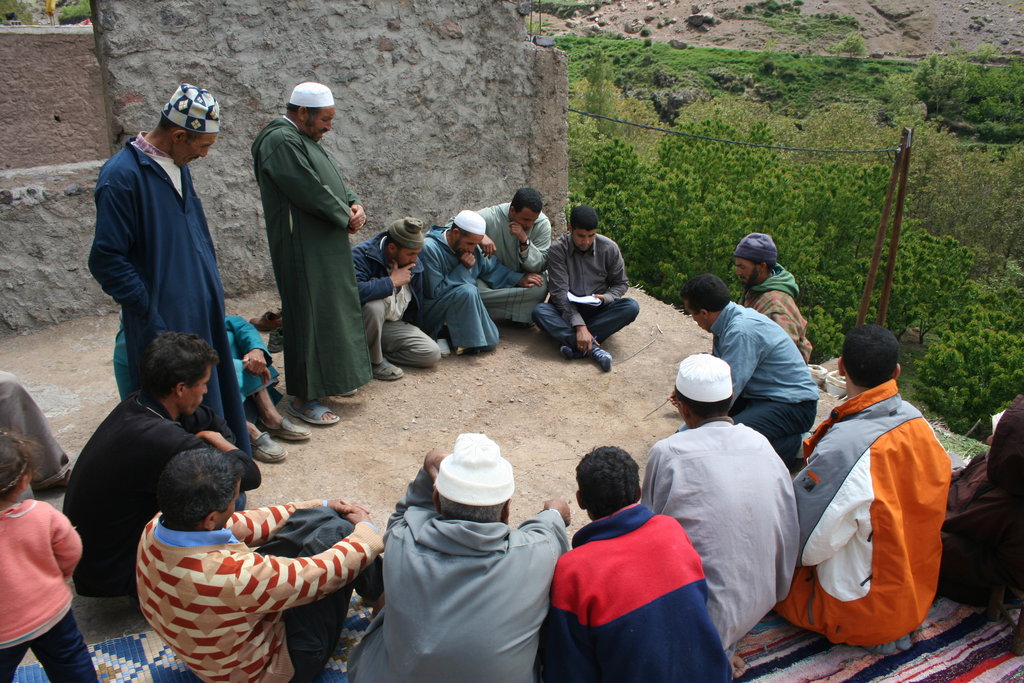
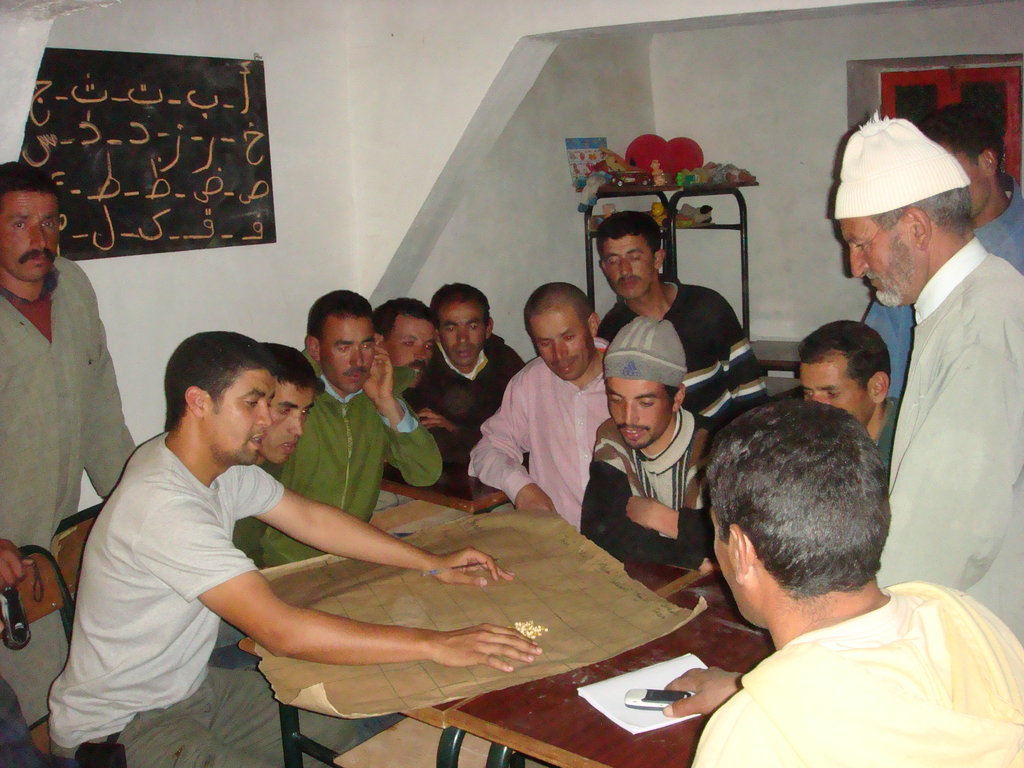
An American Professor, an Indian-American college student, and four Moroccan men, diverse in origin and age, candidly discussed and debated what it means to be a man in an assortment of recognizably local circumstances.
We began the training session by introducing ourselves to one another through the medium of an object that was meaningful to us.
As family heirlooms and personally significant objects were passed around, along with our names, we were instructed to remember the importance of the object, adding a layer to the concept of an immediate introduction.
Our degree of relationships were varied: some were friends, some colleagues, and some strangers. After the introductions, we were asked to recount who we had met and what the personal object had revealed about them.
The training session then continued with an analysis of images that I had generated to display contextually ‘traditional’ and ‘untraditional’ roles of men and women in Morocco.
Many concepts were fairly typical and digestible, like a man scolding his child, or a man being served tea by a woman as he enjoyed the company of his peers, but some were created deliberately to incite discussion.
Imagery of a man cooking for his wife or a changing his baby’s diaper generated immediate reaction which was subsequently funnelled into productive conversation.
While many laughs were shared at the unexpected nature of this exercise, interesting nuance and conversation ensued that highlighted certain complexities and potential double standards that were then reexamined in depth.
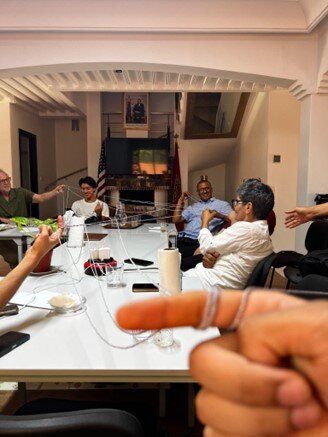
We completed the training session with an exercise using a spool of thread to create a web amongst the participants, displaying a literal and metaphorical symbol of our interconnectedness.
Each person was asked to explain his relationship to another man at the table, and additionally, what that relationship meant to him. The thread was then tied from that man’s finger to the other’s.
This process continued until all men at the table were connected both emotionally and physically. Several heartfelt revelations took place, unraveling the embodiment of what is most ‘positive’ about masculinity.
Ideas of brotherhood, care, and dependability were expressed creating a literal web that showcased our interconnectedness and compassion for one another.
While initially hesitant, our conversations flourished, uncovering the meaningfulness and necessity of positive dialogue amongst men who are culturally conditioned to be stoic and strong.
Things that were understood but unsaid were finally addressed, and the impact of that was palpable.
While the pilot enabled a rare moment of open expression amongst men, the workshop aims to provide this opportunity so that such valuable exchange can become the norm across Morocco.
In mid-July, the first trial of the workshop will take place with the men of two Moroccan villages in the Al Haouz province with subsequent revisions to ensure cultural applicability.
Professor Latrell and his collaborator Shannon Enders, in partnership with the High Atlas Foundation, will continue to refine this workshop to encourage evolving ideas of masculinity among Moroccan men.
As gender roles in modern Morocco continue to evolve, the need for creative solutions that blend disciplines and backgrounds is at an all-time high.
By utilizing the art form of theatre as a medium for cultural discourse, the male-focused empowerment workshop presents one such creative solution.
Project reports on GlobalGiving are posted directly to globalgiving.org by Project Leaders as they are completed, generally every 3-4 months. To protect the integrity of these documents, GlobalGiving does not alter them; therefore you may find some language or formatting issues.
If you donate to this project or have donated to this project, you can receive an email when this project posts a report. You can also subscribe for reports without donating.



Support this important cause by creating a personalized fundraising page.
Start a Fundraiser