By Tagnon Tchekli | Volunteer
For decades, the principle of participation has been a cornerstone of sustainable development. It has been evidenced that projects conceived with communities, rather than for them, are more likely to take root and flourish. At the High Atlas Foundation (HAF), this participatory approach is not just a method; it is the mission. But a critical question remains: is HAF merely facilitating participation, or are they truly harnessing the collective wisdom of the communities they serve?
Indeed, we set out to explore this very question through a new scientific lens: the field of Collective Intelligence (CI). CI is the study of how groups can be smarter than the smartest individuals within them, or the simple addition of the members’ intelligence. Think of a thriving marketplace, a successful team, a flock of birds navigating seamlessly, or a colony of bees or ants in their social organization. These are all examples of collective intelligence in action. Groundbreaking research, like James Surowiecki's "The Wisdom of Crowds," has shown that for a group to be intelligent, it needs four key ingredients: diversity of opinion, independence of thought, decentralized inputs, and a smart method for aggregating all of those contributions into a final decision.
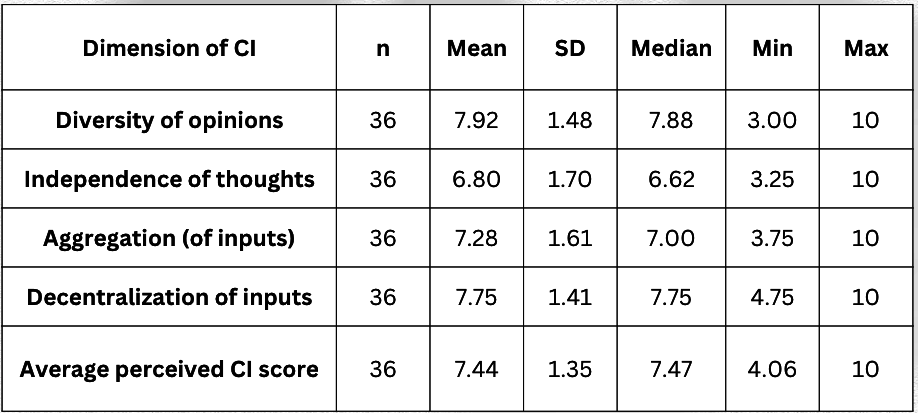
Our research aimed to diagnose whether these ingredients are present in HAF’s work and, ultimately, to provide some recommendations for strengthening this collective brainpower to achieve even greater impact. To do this, we decided to measure the perceived level of CI in HAF’s participatory approach. Thus, we developed a survey based on CI‘s core principles. We collected 36 valid responses from a diverse group of HAF staff, facilitators, volunteers, and community members. The survey asked participants to rate their agreement with statements about their experiences with the HAF’s participatory approach (workshops and meetings) on a scale of 0 to 10.
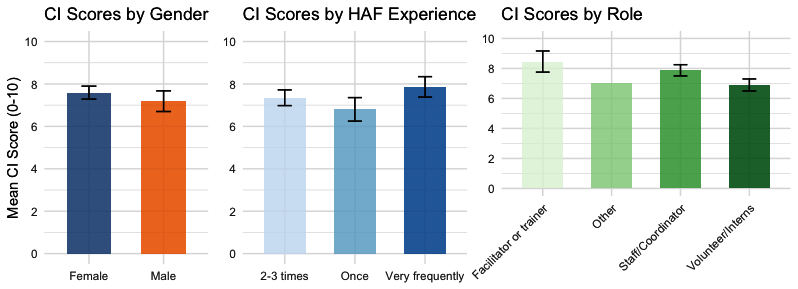
The results were encouraging as illustrated above. The aggregate perceived CI score was a solid 7.44 out of 10. This indicates that people involved with HAF do, in fact, feel that a positive degree of collective intelligence is at work. Breaking this down, "Diversity of Opinions" scored highest (7.92), suggesting that HAF’s processes are successful in bringing a variety of voices to the table. However, the lowest score was for "Independence of Thought" (6.8), pointing to a potential area for improvement. Below is an illustration of the perceived CI scores across the three major demographic groups.
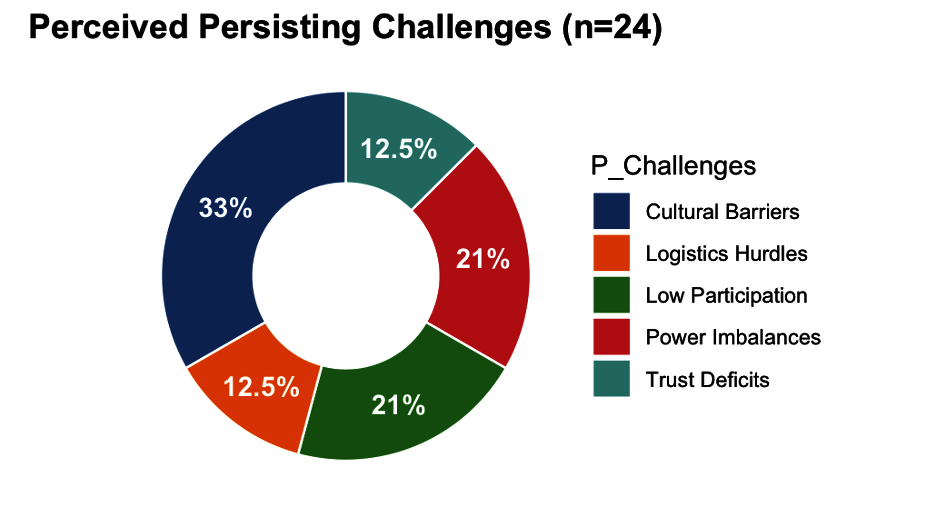
While the overall score is positive, the qualitative data revealed the subtle social and cultural friction that can suppress a community’s full intelligence. The challenges participants reported (figure below) were telling:
§ Cultural Barriers: These were the most frequently cited, including deep-seated respect for elders that discourages younger people from contradicting them, and religious or traditional taboos that limit open discussion.
§ Power Imbalances: Specifically, gender norms were highlighted, with men often controlling conversations in mixed-group settings.
§ Trust Deficits: A lingering distrust of external institutions can make community members hesitant to share their true opinions.
§ Logistical Hurdles: A shortage of trained facilitators and the challenge of reaching remote areas were also noted as practical constraints.
These barriers directly explain the lower score in "Independence of Thought." If participants feel they cannot speak freely for fear of judgment, contradicting a leader, or breaking a social norm, the group loses access to their unique knowledge and perspectives. This is the difference between mere attendance and genuine, transformative participation.
The good news is that the science of CI offers clear pathways to address these challenges. Based on the findings, the following are tailored recommendations for HAF to consciously design processes that foster a smarter, more inclusive collective intelligence:
This study confirms that the spirit of collective intelligence is already alive within HAF’s participatory approach; the community perceives it. Our task now is to move from unconscious competence to conscious design. By intentionally cultivating the principles of CI, actively fostering independent thoughts, strategically aggregating diverse inputs, and thoughtfully integrating technology, we can transform participatory methods.
The goal is to ensure that every community meeting is not just a forum for discussion, but a powerful, synergistic system where the whole truly becomes greater than the sum of its parts. In doing so, we can unlock the profound, untapped intelligence of the communities we serve, ensuring that their futures are shaped by their fullest and smartest collective potential.
Project reports on GlobalGiving are posted directly to globalgiving.org by Project Leaders as they are completed, generally every 3-4 months. To protect the integrity of these documents, GlobalGiving does not alter them; therefore you may find some language or formatting issues.
If you donate to this project or have donated to this project, you can receive an email when this project posts a report. You can also subscribe for reports without donating.



Support this important cause by creating a personalized fundraising page.
Start a Fundraiser