By Ross Deans | GVI Charitable Trust Manager
This project will help us to establish a carbon neutral research base on Curieuse Island in the Seychelles. For this report we thought we would share a story from the field written by one of the wonderful GVI volunteers who participate in research expeditions to support conservation in this pristine environment:
'It was a humid rainy morning as the 3 of 4 (Victoria, Duncan, and I) of us got in the van with GVI staff. All were super friendly and welcoming. After introductions to the other volunteers, we continued on our way to the ferry. To divert our attention from the choppy crossing en route to Praslin, we sat back to a soundtrack of The Mask, broken occasionally by the sounds of other passengers not fairing so well with the journey!
Conor (our 4th volunteer) wasn’t arriving until late on Saturday so we had a chance to settle in before getting stuck into the presentations. On Sunday, all our basic instruction began. One of the first things we learned was how to use a machete. Scholar Michelle took us on a path through the side of a slightly murky swamp. After finding several coconuts, we headed back. Duncan and I were the last two, when all of a sudden a 4ft crab slightly emerged from the water. After a brief glare, it submerged itself again. Duncan and I were unable to say anything, and no one else will believe us. But it is there. Stay at Curieuse and you can see for yourself too...
One by one we dehusked a coconut via a metal husking stake...aka a metal pipe with a flattened end. We turned the coconut in our hand and with the other tapped it with the machete until it cracked. Once in two, we were able to eat the crispy tropical snack and drink the coconut milk. Delicious.
We went down the beach to check on the nests. By moving a few inches of dirt in each nest, Science Coordinator April checked to see if any shells were near the surface. Nest one, nothing. Nest two, nothing. Nest three...
April scooped out a handful of sand and gasped. There in the sand was a baby GREEN turtle. It was a rare experience because Green turtles only nest in the dark and the nests are more difficult to spot. One by one the baby green turtles emerged from the sand to make their epic journey to their new world. Only the females will return to this beach to lay their eggs, in another 30-35 years. After letting them make their way down the beach, we gathered the turtle and sand into our hands to help them across the surf. The feeling of assisting something so precious, with the hope that maybe that one will survive, is amazing. The exhilaration of watching this process, the hatch-ling dig out, and make it to the sea, is something I have seen countless times on the Discovery channel. But to watch it in real life, to be a part of that experience, is something so breathtaking that words can hardly justify it. As the turtle entered the water, its fins being pushed to the limit as designed, brought complete satisfaction that projects like this hope to achieve. That was the great part. Sadly, there were a few that did not make it. As with all things, in the battle for survival not everything wins. There were over a hundred egg shells, a representation that many made it to sea, but a few still remained to continue the cycle of life through decomposition.
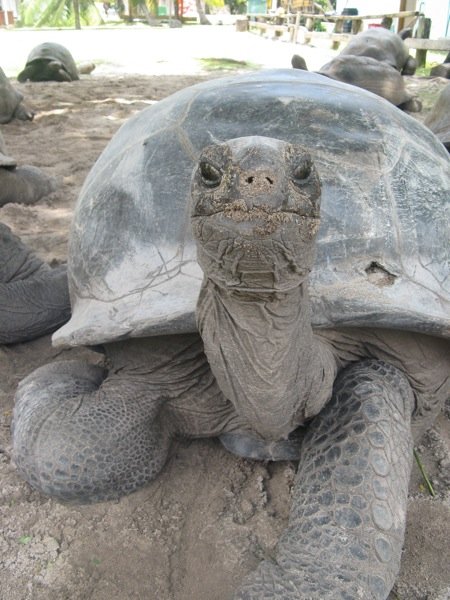
The next day was our first real turtle walk day. We came across our first giant tortoise. We saw more tortoises and eventually arrived at the Ranger Station where most of them are concentrated. When we eventually got to the beaches, we saw a couple of tracks. Everyone had a different job, measuring, recording, digging etc . We were talking and laughing along our route. At one of these spots, there was a Hawksbill Turtle covering up her nest. We silently watching in awe as she worked so hard to do what instinct has guided her to do. After some time, she finished covering up and we watched her scooting back into the sea.
We each checked more nests. One of them yielded more hatchlings! Tragically, they seemed to be the bottom of the nest hatchlings and were weak, leading us to believe that they were the last ones to make their way to the sea from the nest.
Everyone is great and gets along well. There is laughing and teamwork both in duties and for fun. It has been a great beginning for our adventure on Curieuse Island.'
Project reports on GlobalGiving are posted directly to globalgiving.org by Project Leaders as they are completed, generally every 3-4 months. To protect the integrity of these documents, GlobalGiving does not alter them; therefore you may find some language or formatting issues.
If you donate to this project or have donated to this project, you can receive an email when this project posts a report. You can also subscribe for reports without donating.